Thursday, February 1, 2018

Essentials - Week 14

Good afternoon Emoms!  We had a fun day yesterday in class!  I hope you enjoyed it, too!


EEL - We reviewed from last week and added information about Verbs.

Structure - Complex
Purpose - Imperative
Pattern - S-Vt-IO-DO

Reviewing our sentence structure and pattern, we tried it out in the Imperative purpose. The Imperative purpose is a command. Remembering that the Imperative purpose has an implied 2nd person (you) as the subject.  

         Jesus made me a crown - to - (you) Make me a crown. 

We began studying about Verbs and Verb Anatomy, specifically Active and Passive Verb Voice.  I dropped the papers on the floor and described how I dropped the papers (active voice) and how the papers were dropped (passive voice). 

Active voice - the subject does the action
Passive voice - the action is done to the subject.

We read the blueprint for changing active to passive voice on page 221 and tried out the formula on a few sentences.  I think the kids began to understand how to change the voice. Work on this at home with some simple sentences to help cement the understanding.


We also did our ATS this week on the #3 sentence from week 14. Next week, week 15, we will begin adding on tasks #5 and 6.  We will take it slow and easy.  Show your kids what #5 and 6 involve and hopefully it won't be such a shock.  :)

HOMEWORK - New chart - DD (passive voice: to love).  We didn't get to it in class but it has examples of the passive voice. Review charts A, E, H, I, L, M.  Chart Challenge!!

IEW - We read our papers in our groups this week.  I heard a lot of encouragement from each other - great job!

We played Sentence Stretch this week and it was great fun!  I enjoyed hearing the kids getting excited about filling in the words/clauses to stretch our sentence.  We will do this again!

We are still in Unit 6 and multiple sources.  There are 2 choices for source texts this week - Thomas Edison and Alexander Graham Bell.  Choose which one your child wants to write about and have at it!

I introduced 2 new sentence openers - #3 - -ly adverbs and #4 - -ing openers.  They are basically what you see.  You start the sentence with an -ly adverb or an -ing verb. Using the -ing, the subject must be doing the -inging.  The -ing opener will be attached to a phrase and be followed by a comma and a complete sentence. 

Next week, week 15, I need to know who your child is writing about for FoH.  I'll have a list of everyone's names and they can add their subject to it.  

HOMEWORK - Lesson 17 or 18 in the HBW for your paper this week. Finalize your FoH topic and begin gathering sources.

PASSWORD: Definition of Active/Passive voice.
Active voice: subject does the action
Passive voice: the action is done to the subject

Have a great week! 


Saturday, January 27, 2018

Essentials - Week 13

Welcome back!  It's time to jump right back in where we left off!


I explained to the kids about our semester Chart Challenge.  We will have an epic Nerf gun war and other rewards IF they complete the following number of charts:
250 charts - everyone receives 25 Nerf darts
500 charts - everyone receives 50 Nerf darts
750 charts - Nerf war and ice cream
1,000 charts - Nerf war, ice cream and taco bar at my house!

Encourage your kids to complete as many charts as they can! If you use the Chart Tracker it will make it a lot easier and you can keep the charts at home for posterity!  ;)  If you have questions, please ask!

EEL - New structure and pattern!
Structure - Complex
Purpose - Declarative and Exclamatory
Pattern - S-Vt-IO-DO

We started class reviewing S-Vt-DO pattern and then morphed it into S-Vt-IO-DO.  Doing this made it easy to understand the new pattern.

Remember: an IO is a noun or pronoun that answers the question to whom or for whom.  It does not receive the action of the Vt.  There has to be a DO to have an IO. The IO will come between the Vt and the DO. 


                       SN     Vt       IO  aa    DO
                    Jesus  made  me   a   crown.

Jesus made a crown for whom? me - IO

We started discussing the Complex Structure as well.  We reviewed Independent Clauses by referring back to the Simple and Compound structures.  Then we discussed dependent/subordinate clauses. Independent clauses have a S-V and can stand alone as a sentence (makes complete sense).  A dependent/subordinate clause also has a S-V but is dependent on the Independent clause to make sense.  The dependent clause makes a statement or answers a question about the independent clause.

Tom, who loves animals, owns a Shetland sheepdog.

While 'who loves animals' could stand on its own as an interrogative question, it is a dependent clause in this sentence because it is describing Tom.  It is an adjectival clause.

Two kinds of clauses:

Adjectival clauses begin with a relative pronoun and usually begin with who or which.  

Adverbial clauses begin with subordinating conjunctions - www.asia.wub - and answer the Adverb questions. 

If our kids can begin recognizing who/which and www.asia.wub in sentences, they will immediately KNOW that they are looking at a clause and will be able to identify what kind and label it as such!  So exciting!

I don't have a picture of the chart I made but here is the picture that I based mine on:


We also discussed Phrases.  In the most simple terms, Phrases do not contain a S-V.  There can be adjectival, adverbial or noun phrases.  A good example of a phrase is a Prepositional Phrase.  

In the garden, over the hedge, under the water

We used the #3 sentence in our weekly practice sentences to review all we had learned that day.  We did the question confirmation for both the Independent and dependent clauses and discovered that they each had their own pattern. Learning all this info will really stretch our kids' thinking! 

HOMEWORK - Moms - please read through the upcoming week's lesson.  It will benefit you and your child both if you are aware of what is coming in class!

Kids - New Chart - M - Complex structure.  Work on this as much as you can.  The quicker they learn the structure, the more successful they will be as they write their papers.  Many charts to review this week - A, E, F, H, I, L

IEW - New Unit - Unit 6 - Summarizing Multiple Sources

In preparation of writing their FoH papers, we will be focusing on different aspects of writing a 'research' paper.  This week, summarizing multiple sources is the first step.

I reminded the kids that when they are finding their facts for their KWO they don't need to write *everything* down.  We are SOME-a-rizing the information.  They only need to use some of the info, what they think is interesting or important from the source text. 

We began by reading through the first text about the Civil War and the kids highlighted or underlined what sentences they wanted to use. We completed a KWO on the board together with the facts they shared.  Then we read the second text and did the same thing. 

After we completed the second KWO I described to the kids how to fuse their KWOs into one KWO using facts from each outline. We decided on the info we thought was most interesting or important.  I showed the kids that they didn't have to use their KWO in the order they had written them.  We combined sentences together if they had the same info in them.  We didn't get to writing a topic sentence or a clincher though.

I think it helped them to see that they are not bound by the KWO they create.  They have the freedom to write what they want based on the KW they chose but they can rearrange their sentences to write a paper that expresses what they want to say. It leads to such freedom in writing!

I neglected to discuss the #3 opener - the -ly adverb.  Having used -ly adverbs in writing already this year, I don't think it will be a problem for the kids to begin using this in their papers.  It's probably already happening without the kids realizing it! :)

HOMEWORK - Moms - help your kids read and write their KWO if they didn't copy the one in class.  Use the checklist on page 130 to include as many dress ups as your child is able to do. Remember EZ+1!

Kids - read the source texts, highlight or underline for your KWO, fuse your KWOs together and write that paper!  You can do it! 

PASSWORD - Adjectival clauses have who/which; Adverbial clauses have www.asia.wub

Have a great week!  See you on Wednesday! :)


Saturday, January 20, 2018

Essentials - week 12

Hello Emoms!  Week 12 was a lot of fun - here's what we did!

EEL - Structure - Compound
          Purpose - Interrogative
          Pattern - S-Vl-PN and S-Vl-PA

We added the Interrogative purpose to our Compound Sentences.  Nothing was new this week, we are just building on what we already know.

We reviewed how to make an Interrogative sentence (3 ways) and discovered that when asking "Is Jesus holy..." The Verb linking moves to the beginning of the sentence.  We remembered that a way to make an Interrogative sentence is to add a Helping Verb at the beginning of the sentence.  The verb 'Is' can either be used as a Helping Verb or a Verb linking - in this instance we moved the Verb linking to the beginning of the sentence and made an Interrogative sentence.

Clear as mud?  I remember that there was quite a bit of discussion about this because I kept saying Helping verb when we weren't adding one, just using the linking verb in the sentence.  Thanks for your graciousness and patience with me as I'm still learning and studying!

We used question confirmation to label our sentence and used the ATS to record and diagram.  Starting week 15 we will begin using all 6 tasks - just a heads up!

We did a Mad Lib as part of our end of semester fun and was able to go over all the parts of speech.  

We also found out that we had copied/recorded over 300 charts and the kids were rewarded with a Sonic gift card! So proud of all their hard work!  There will be another challenge for this semester!

IEW - We didn't read any papers this week.  I think everyone needed a break.  :)  I passed out a Faces of History packet that I had printed and we went over that and talked expectations concerning FoH.  Remember that FoH is optional - you are the teacher, you decide what your child is capable of doing.  No pressure from me. If you decide not to participate in FoH, the weekly writing assignments should still be completed in order for the kids to continue practicing what we are learning in class. 

We talked about what week 24 will look like, with the option to change our plans as needed.  Costumes are optional for the kids but they do lend to the fun. 

We will talk some each week about FoH and will do some work on it in class as different things come up in our weekly lessons. I have some other handouts and tips/tricks to share with you later. 

The last 30 minutes of our time together we had a hot chocolate bar based on Chart A - 4 kinds of stir ins, 4 kinds of toppings and 7 kinds of cookies!  It was so much fun sharing that with the kids and they were all very careful and respectful of each other and the moms as they waited in line.  I just love your kids!

Looking ahead to the spring semester - begin talking with your child about who they want to do their FoH paper on and let me know. We want to avoid having the same subjects of our papers.

As always, if you have any questions or comments, please let me know!  :)


Thursday, November 16, 2017

Essentials Week 11

Woo hoo!  Week 11!  Remember: no class next week!  Week 12 is on November 29th!

EEL: Same structure, new purpose and 2 patterns!

Structure: Compound
Purpose: Exclamatory
Patterns: S-Vl-PN and S-Vl-PA

We began class taking a few minutes to fill in Chart B from memory.  Proud of the kids - they worked hard!  We also reviewed linking verbs as they are in both of the patterns we reviewed today.

We remembered that a Predicate Nominative *renames* the subject and a Predicate Adjective *describes* the subject,

Jesus is God. - S-Vl-PN  Jesus=God
Jesus is holy. - S-Vl-PA  Holy describes Jesus

I then passed out sentences to everyone to work out on their ATS.  We had Simple and Compound structures and the 4 patterns we've studied so far - S-Vi, S-Vt-DO, S-Vl-PN and S-Vl-PA.  I appreciated Caleb and Selah coming forward and demonstrating how they labeled and diagrammed their sentences.  It's good for the kids to see each other working these things out!

We did a sentence together on the board from our week 11 sample sentences:
The bear is a carnivore, and he is hungry!

We labeled all the parts of speech using our question confirmation flow chart that I handed out yesterday. Please use this at home to encourage your kids to begin identifying sentence patterns and parts pf speech quicker. I'll be using the questions in class in various ways to help solidify their knowledge.

HOMEWORK: Mom: Week 12!  Kids: ATS!  Charts!  10 more charts each by week 12 and there will be hot chocolate and cookies as an extra reward!  :)


IEW: We broke into different groups and read our Writing from Pictures aloud to one another.  Then I had each group write a poem using prepositions at the beginning of each line.  Our kids are so very creative!

We learned about Similes and Metaphors today.  Similes use 'like' or 'as' to compare two things.  Metaphors make an indirect comparison. 


The snow was like softly falling feathers. - Simile
The snow was a white blanket. - Metaphor

We brainstormed a bit from the suggestions in our HBW in hopes of making the two decorations a little more accessible to the kids.

Similes and Metaphors should be used in papers now, IF your child is ready to add that to EZ+1.  Please don't stress if they're not added to papers.  

Still working with Writing from Pictures and writing about the Underground Railroad this week. I read a bit of history to make it more real to the kids.  Remind them that they should look at the picture, write their central fact based on the picture, then write their KWO about what had happened leading up to the picture.  Ask the questions on the right of the page to get words for the KWO. I think this style of writing is easier for them and I'm looking forward to hearing their papers on week 12!

HOMEWORK: Mom: help your kids write their KWO!
Kids: KWO, rough draft and final draft!  Mark all your sentence openers and decorations!

Have a Happy Thanksgiving, friends.  I am thankful for each and every one of you and each of your children.  You bless me so much!

As always, if you need anything, please let me know.

Blessings,
M


Thursday, November 9, 2017

Essentials Week 10

Good morning Emoms!  Life is plugging right along and I'm seeing progress in each of your children.  How encouraging!

WORDS OF ENCOURAGEMENT

EEL: New sentence pattern and our last part of speech!

Part of Speech: Adjectives - Chart L


Adjectives modify nouns or pronouns and ask questions What kind? Which? How many? Whose?

We spent some time marking information on Chart L to hopefully make it make sense.  We won't need a lot of the information on the chart until we begin using our Quid et Quo and we have to break down what kind of Adjective the word is.  But it is beneficial to begin learning it now so the process of QeQ is easier. Copy the chart and begin committing it to memory!

Structure: Compound
Purpose: Declarative
Pattern: S-Vl-PA

Same structure and purpose this week but a new pattern!  PA = Predicate Adjective.  PAs follow a linking verbs and describes the subject. 

The list of linking verbs doesn't change but the to be verbs aren't used as frequently.  You'll encounter the other linking verbs more often when you have a PA in your sentence (feel, become, remain, taste, etc). Continued work on Chart C - Verbs - will be helpful to the kids in recognizing the different kinds of verbs.  If our kids can immediately recognize linking verbs, then the sentence can only be one of two patterns.  This makes parsing much simpler!

These particular linking verbs can also be used as action verbs which changes the sentence pattern.  Following the question confirmation with the practice sentences will help the kids become familiar with the questions to ask to know what kind of verbs, adjectives, direct objects are in their sentences. Check your sample sentence exercises in the back of each week's lesson. 

HOMEWORK: Mom - Read ahead to week 11!  There's a lot of review next week but your prior knowledge of what's coming will help your kids!
Kids - Charts L, C and G!!  Do your charts - 10 more each in 2 weeks to reach our goal!

IEW: Unit 5 - Writing from Pictures

New unit this week and more opportunity to be creative!  Writing from pictures directs our kids to look at a picture and describe what they see, then allows them to ask questions to tell what happened before the picture.  Look at this unit as "Event Description".

Still working with the KWO the kids tell 3 things as the 'central fact' of the paragraph. Then they continue on the KWO with 3 more words describing the scene using the questions What (thinking, saying doing)? When? Where? Why? How? Before? After? Outside?


You read or have your kids read through each part of the KWO being as descriptive as possible. They will begin to see how the words can flow easily as they tell the story in their own words. 

Each paragraph should have a clincher and the final clincher should repeat or reflect the title. Some helpful info: If younger kids are having difficulty with constructing clinchers that meet all the criteria, they can repeat the central fact exactly then rewrite with a synonym.  Just choose a few words to change.

The kids can be as creative as they'd like. The pictures this week are about the Gold Rush.  Have fun with this!  

HOMEWORK: Mom - Read through the next lesson - Lesson 14 - Escape on the Underground Railroad.

Kids - Finish your KWO and write your story about the Gold Rush.  Can't wait to hear them!

PASSWORD: Definition of an Adjective.

Have a great week! If you have any questions or need anything, please let me know!

M


Thursday, November 2, 2017

Essentials Week 9

Hello, hello!  Week 9 is in the books!  What a fun day we had yesterday.  Anyone need a glass of milk?  :)


WORDS OF ENCOURAGEMENT

I AM the true vine, and my Father is the gardener.
John 15:1

I AM the God of Abraham...
Matthew 22:32

God gives us a glimpse of who He is in His word. God is all these things and more! God created language so we can know Him better.  God is who He says He is!  How comforting to know this!

EEL: We began our EEL study this week with a rousing game of I have, who has? This is always fun.

Structure: Compound Sentence (FANBOYS)
Purpose: Declarative
Pattern: S-Vl-PN

Linking verbs link 2 words together - the subject to the noun or adjective that comes after the verb. (We will hear about adjectives next week -week 10). Linking verbs rename the subject and have NO ACTION. The most common linking verbs are the principal parts of the verb 'to be'. If you see a 'to be' verb in a sentence, it is most always a linking verb. 


A Predicate Nominative is a noun or pronoun that describes the subject. Predicate because it comes after the verb and Nominative as that is the Subject (check Chart E - Nominative is a Latin Noun Case for the subject)
S  Vl          PN
    Bob is a ball hitter. 
Bob=ball hitter.  Ball hitter is a noun that describes Bob.  You can switch the sentence around: The ball hitter is Bob.  Ball hitter=Bob.  

Make sure your kids aren't confusing S-Vl-PN with S-Vt-DO.  Have them check their verb - that's the way to make the distinction.  Vt - there is action being transferred.  Vl - No action at all. We spent a few minutes with sentences written both ways to show the kids the difference. 

There is a list of Linking verbs on Chart C.  It is important that our kids memorize the list as it will make it easier in the future to recognize the S-Vl-PN/S-Vl-PA pattern.  The 'to be' verbs are used most often with PN, the other verbs are used more often with PA (week 10!). 

We worked with our ATS tasks 1-4 on the sentence Our Lord is God, so Jesus is my Savior using our new sentence pattern. Continue to work with this sentence is you'd like to cement the pattern in your kids brains.

Chart K begins the interesting work for Verb Anatomy. Using the verb 'to be' we begin to break it down and see all the different tenses of that verb. Copying and eventually memorizing this verb, plus others, will help in he future in parsing.  1st tour students need only to copy the Simple tense to start.  2nd/3rd tour kids should be able to copy all of it.  Do what's best for your kids. 


HOMEWORK: Mom: Read week 10 and become smarter than your kids! ;)
Kids: Chart K for sure, then review Charts C&D.  We are still working toward our goal of 260 charts!  Do your charts and help your class!!

IEW: We read our papers in our groups this week and I heard a lot of encouragement from the kids to one another. That makes me so proud of our kids. :)

This is our last week to "Some"-a-rize a reference!

We read two examples of paragraphs at the beginning of our time together. We discovered that the 2nd paragraph gave more information and was more interesting to listen to. We talked about varying the length of sentences and beginning sentences with things other than the subject.

This is where Prepositional Phrases comes in.  Using prepositional phrases gives more information about the sentence and captures the readers attention. Using a prepositional phrase as a sentence opener is the #2 sentence opener. When you use one, mark them with a 2 in the left margin. 

The kids gave me some prepositional phrases and we used them as the opener to sentences we completed together.  I don't think I've laughed as much with the kids.  It was so fun and it showed them how to use prepositional phrases as the opener to sentences to make them more interesting. :)


We read our source text together, the Trail of Tears, and they began a KWO with you.  We went over the checklist found at the end of the chapter and I reminded everyone that that is just a list of all the things we have covered so far this year.  It's not the list to check off to make sure you get everything in.  You know your child best and can scale the checklist to your child's ability. EZ+1.

HOMEWORK: Mom: P&P Monday night, Nov 6 at 6:00 pm in the annex.  Jennie and Valerie are in charge of our food and theme!  Read ahead about Unit 5 in your TWSS - writing from pictures.

Kids: Finish your KWO and find a way to use a prepositional phrase!

PASSWORD FOR NEXT WEEK: Tell me an example of a #2 sentence opener - a sentence with a prepositional phrase at the beginning!

Looking forward to seeing everyone Monday night!  Let me know if you can't make it!  Thanks!

Have a blessed weekend!

M


Saturday, October 28, 2017

Essentials Week 8

Good morning Emoms!  Sorry for the delay in publishing the blog.  Todd left yesterday for a 4 month TDY and I spent the time with him.  I'm sure you understand! :)

WORD OF ENCOURAGEMENT
"...let your light shine before men, that they may see your good deeds and praise your Father in heaven."
Matthew 5:14-16
What privilege we have to study and learn the English language so we can better share the word of God in spoken and written words!

EEL: We started with a sentence on the board again and worked our ATS tasks 1-4.
Jesus loves me, and He loves you.

New material this week:
Structure: Compound (FANBOYS)
Purpose: Interrogative
Pattern: S-Vt-DO

I introduced Interrogative purpose in the Compound structure this week.  Remind your kids of the three ways to make an Interrogative sentence:
1. Add a ?
2. Use an Interrogative pronoun as the subject (Who, Whose, Whom, Which, What)
3. Add a helping verb - do, does, did, has, have, had...

When diagramming your Compound Interrogative sentence and use a helping verb, the helping verb comes before the main verb on the predicate side of your diagram.

Phrase: We were reminded that a phrase DOES NOT contain a subject or verb and it may be used as a single part of speech.  This led to our next part of speech...

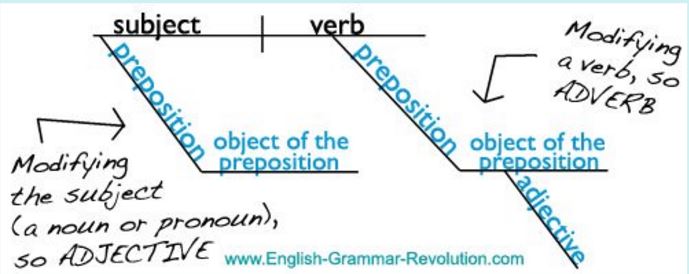
P.O.S. - Prepositions: relates a noun or pronoun to another word.  (Pr)

We saw how a Preposition with the noun/pronoun makes a Prepositional Phrase and the noun/pronoun is called the Object of the Preposition (OP)

                                    Pr  AA      OP   
 Bobby hugs his mother in the morning.
(AA = Article Adjective)


Every prepositional phrase answers either an adverbial question or an adjectival question. We only focused on Adverbial this week - we will get to Adjectival on week 10.  The above picture is an AMAZING way to remember how to diagram prepositional phrases!!

Remembering what the Adverb definition is and the questions it answers...
How? When? Where? Why?
How often? How much?
To what extent? Under what condition?

In the prepositional phrase above, we find that 'in the morning' answers When does Bobby hug his mother?  So the prepositional phrase is an Adverbial Prepositional Phrase. You need this information in order to place the phrase in your diagram correctly. 

At the end of class we used the sentence 'Did Dad love me, and has he brought presents?' on our ATS to practice the Interrogative purpose.  We didn't get to using/diagramming with prepositional phrases this week but we will begin using them soon!  As you're practicing with the ATS remember that your can use the same sentence multiple times to gain confidence in the process! 

HOMEWORK: Mom: read ahead for week 9. There may be things that we don't get to in class; therefore, if you read the week's lesson you can introduce new info to your child!

Kids: ATS and charts!  Chart J is prepositions - do this one at least once!  We are still working toward a goal of 260 charts by week 12 to earn the Sonic gift card - help our class out to get there.  :)


IEW: We gathered around our tables and read our papers.  The kids are doing a great job listening for dress ups in their friend's papers!

We spent some time learning about Quality Adjectives.  We found that the now banned adjectives pretty/ugly and big are vague and they don't lend themselves to giving the reader a picture of what is happening.

We also learned that Because isn't the only way we can give more information in a sentence. The kids can now use www.asia.b as a clausal dress up.

When While Where.As Since If Although.Because

Use these words to begin a sentence or at the end of a sentence to provide more information.

While Thomas Jefferson was the third president, he wrote the Declaration of Independence.

Thomas Jefferson wrote the Declaration of Independence while he was the third president.

***If the www.asia.b clause is at the beginning of the sentence, use a comma at the end of it.  If it is at the end of a sentence, a comma isn't necessary.***

The kids are now to use 1 www.asia.b clause in every paragraph of their papers.  But remember: EZ+1!!!  If your child isn't ready to add this new dress up, don't use it.  Stick to what they know!

We are still in Unit 4 - 'Some'-a-rizing a Reference.  This week's source text is The Louisiana Purchase.  I demonstrated the method for writing their KWO this week.

1. Read through the entire source text.
2. Read through the source text again and mark interesting (to them!) facts.  Choose 4-7 facts.
3. Read again and add the facts to the KWO.  Remember - you can change the order of your facts but get them on the KWO first!
4. Read then write your KWO in your own words.

Also, a good way to make sure all the above steps get done is to assign steps to days of the week.  Since we meet on Wednesday, this is how we do it at our house:

Wednesday: class day - Timothy generally begins working on his KWO in class.
Thursday: Read through the source text together and validate the facts he found interesting.
Friday: Finish the KWO and he reads it aloud to me so I can make suggestions for dress ups, etc.
Monday: He writes his rough draft and adds in dress ups, etc that he knows.  We watch for banned words!
Tuesday: He dictates his paper to me and I type it in.  He points out where his dress ups are and tells me how to mark them in his paper. Then he reads it aloud again and we make changes if needed.

You may have a system in place that works for you - that's great!  If not, and you're struggling to get the IEW portion done at home, try the system above and see if it works for you.  Tweak it if needed to fit your style.  I put it here in order to give some guidance if needed.  I don't want anyone to feel behind or defeated because this is a tough way to write!  Please let me know if you have any questions or need some help!

HOMEWORK: Mom: read through Lessons 12: Trail of Tears.  Still utilizing Unit 4!
Kids: KWO and paper! You can do it!

PASSWORD FOR NEXT WEEK: What does www.asia.b stand for?


Have a great weekend - see you on Wednesday!  As always, please, PLEASE contact me if you need some encouragement or help!  That's what I'm here for!!

Be blessed!
M