Saturday, October 28, 2017

Essentials Week 8

Good morning Emoms!  Sorry for the delay in publishing the blog.  Todd left yesterday for a 4 month TDY and I spent the time with him.  I'm sure you understand! :)

WORD OF ENCOURAGEMENT
"...let your light shine before men, that they may see your good deeds and praise your Father in heaven."
Matthew 5:14-16
What privilege we have to study and learn the English language so we can better share the word of God in spoken and written words!

EEL: We started with a sentence on the board again and worked our ATS tasks 1-4.
Jesus loves me, and He loves you.

New material this week:
Structure: Compound (FANBOYS)
Purpose: Interrogative
Pattern: S-Vt-DO

I introduced Interrogative purpose in the Compound structure this week.  Remind your kids of the three ways to make an Interrogative sentence:
1. Add a ?
2. Use an Interrogative pronoun as the subject (Who, Whose, Whom, Which, What)
3. Add a helping verb - do, does, did, has, have, had...

When diagramming your Compound Interrogative sentence and use a helping verb, the helping verb comes before the main verb on the predicate side of your diagram.

Phrase: We were reminded that a phrase DOES NOT contain a subject or verb and it may be used as a single part of speech.  This led to our next part of speech...

P.O.S. - Prepositions: relates a noun or pronoun to another word.  (Pr)

We saw how a Preposition with the noun/pronoun makes a Prepositional Phrase and the noun/pronoun is called the Object of the Preposition (OP)

                                    Pr  AA      OP   
 Bobby hugs his mother in the morning.
(AA = Article Adjective)
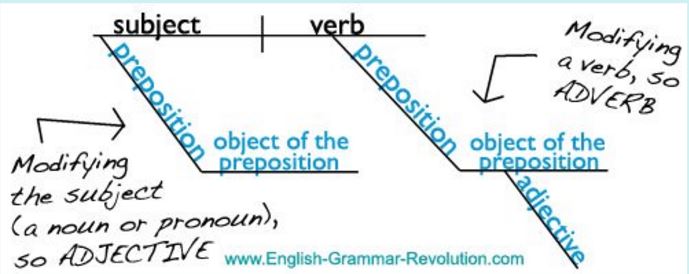


Every prepositional phrase answers either an adverbial question or an adjectival question. We only focused on Adverbial this week - we will get to Adjectival on week 10.  The above picture is an AMAZING way to remember how to diagram prepositional phrases!!

Remembering what the Adverb definition is and the questions it answers...
How? When? Where? Why?
How often? How much?
To what extent? Under what condition?

In the prepositional phrase above, we find that 'in the morning' answers When does Bobby hug his mother?  So the prepositional phrase is an Adverbial Prepositional Phrase. You need this information in order to place the phrase in your diagram correctly. 

At the end of class we used the sentence 'Did Dad love me, and has he brought presents?' on our ATS to practice the Interrogative purpose.  We didn't get to using/diagramming with prepositional phrases this week but we will begin using them soon!  As you're practicing with the ATS remember that your can use the same sentence multiple times to gain confidence in the process! 

HOMEWORK: Mom: read ahead for week 9. There may be things that we don't get to in class; therefore, if you read the week's lesson you can introduce new info to your child!

Kids: ATS and charts!  Chart J is prepositions - do this one at least once!  We are still working toward a goal of 260 charts by week 12 to earn the Sonic gift card - help our class out to get there.  :)


IEW: We gathered around our tables and read our papers.  The kids are doing a great job listening for dress ups in their friend's papers!

We spent some time learning about Quality Adjectives.  We found that the now banned adjectives pretty/ugly and big are vague and they don't lend themselves to giving the reader a picture of what is happening.

We also learned that Because isn't the only way we can give more information in a sentence. The kids can now use www.asia.b as a clausal dress up.

When While Where.As Since If Although.Because

Use these words to begin a sentence or at the end of a sentence to provide more information.

While Thomas Jefferson was the third president, he wrote the Declaration of Independence.

Thomas Jefferson wrote the Declaration of Independence while he was the third president.

***If the www.asia.b clause is at the beginning of the sentence, use a comma at the end of it.  If it is at the end of a sentence, a comma isn't necessary.***

The kids are now to use 1 www.asia.b clause in every paragraph of their papers.  But remember: EZ+1!!!  If your child isn't ready to add this new dress up, don't use it.  Stick to what they know!

We are still in Unit 4 - 'Some'-a-rizing a Reference.  This week's source text is The Louisiana Purchase.  I demonstrated the method for writing their KWO this week.

1. Read through the entire source text.
2. Read through the source text again and mark interesting (to them!) facts.  Choose 4-7 facts.
3. Read again and add the facts to the KWO.  Remember - you can change the order of your facts but get them on the KWO first!
4. Read then write your KWO in your own words.

Also, a good way to make sure all the above steps get done is to assign steps to days of the week.  Since we meet on Wednesday, this is how we do it at our house:

Wednesday: class day - Timothy generally begins working on his KWO in class.
Thursday: Read through the source text together and validate the facts he found interesting.
Friday: Finish the KWO and he reads it aloud to me so I can make suggestions for dress ups, etc.
Monday: He writes his rough draft and adds in dress ups, etc that he knows.  We watch for banned words!
Tuesday: He dictates his paper to me and I type it in.  He points out where his dress ups are and tells me how to mark them in his paper. Then he reads it aloud again and we make changes if needed.

You may have a system in place that works for you - that's great!  If not, and you're struggling to get the IEW portion done at home, try the system above and see if it works for you.  Tweak it if needed to fit your style.  I put it here in order to give some guidance if needed.  I don't want anyone to feel behind or defeated because this is a tough way to write!  Please let me know if you have any questions or need some help!

HOMEWORK: Mom: read through Lessons 12: Trail of Tears.  Still utilizing Unit 4!
Kids: KWO and paper! You can do it!

PASSWORD FOR NEXT WEEK: What does www.asia.b stand for?


Have a great weekend - see you on Wednesday!  As always, please, PLEASE contact me if you need some encouragement or help!  That's what I'm here for!!

Be blessed!
M


Thursday, October 19, 2017

Essentials Week 7

Second 6 weeks - here we go!

Words of Encouragement
“Train up a child in the way he should go, and when he is old he will not depart from it.” Proverbs 22:6
While it seems like a burden some days and there is promise in our work, we and our children will be blessed by this process.  God's direction is where we are headed! 


EEL: We started the day with practicing on our ATS - Jesus loves me, so Jesus loves you.  The kids knocked this out of the park!  They were engaged and on task!

Structure: We are still working with Compound structure. Remembering our FANBOYS that connect two complete sentences. 

Jane dusts the furniture AND Jack takes out the trash.


Purpose:  Imperative purpose.  These sentences give a command, have an implied (you) as the subject and require a 2nd person verb.  2nd person meaning you are talking to someone else.

(you) Jane, dust the furniture and (you) Jack, take out the trash.

Using the Imperative purpose the person we are talking to becomes a Noun of Direct Address. (NDA)  while the (you) becomes the subject.  NDA describes who we are talking about. For example, in the sentence above Jane and Jack now become NDA because the subject is (you).

Pattern: We stayed with S-Vt-DO this week and practiced it in our ATS.

P.O.S: Adverbs - we sang the Adverb song from Foundations last year and we answered all the questions using the sentence Mama danced.

Mama danced.
How?   terribly
When?    yesterday
Where?   in the hot tub (prepositional phrase!)
Why?  because she was happy (subordinate clause! -because)
How often?    daily, frequently
How much?   abundantly
To what extent?    very slowly, rather clumsily
Under what condition?    while it rained (subordinate clause! www.asia)

Adverbs can be found on Chart I in your Gear section.  Have the kids copy this! 


We also learned another type of Noun: the Appositive (AP).  An appositive is a noun (or pronoun) directly beside another noun that describes it. 

My dog Rover can learn tricks.
Rover is the Appositive - it describes dog.

HOMEWORK: Mom - read week 8 - new pattern next week!  Practice the ATS with your kids!  Have them read a sentence to you and work out the ATS together!
Kids: Charts!  We are still working toward the Sonic gift card!  260 charts by week 12!!

IEW: We changed groups this week for reading our papers.  The kids really worked hard over the break.  I heard numerous examples of dress ups!  We split into groups this week but because we were missing a few people, and will have others out next week, I will wait to assign groups until everyone is back.

I introduced the Topic Sentence and Clincher this week.  The topic sentence introduces what the paragraph is about.  The clincher ties a nice bow on the end of the paragraph by repeating or reflecting 2-3 words from the topic sentence.  From here on out, each paragraph in your child's paper should have a topic sentence and a clincher.

We discussed researching a topic and realized that if we were to write a paper on all the information we found on a topic, it would be too long to read!  This is where Unit 4 comes in: Summarizing a Reference.

I told them to "Some-a-rize" their reference/source text.  They need to choose the most interesting information and put those facts into their KWO.  Remember mommas:

Hands ON structure and style
Hands OFF content

This style of writing can be fun and exciting!  We are using the HBW Declaration of Independence as our source text but please find a reference that will interest your child if the one provided doesn't capture their attention. 

Remind the kids that they are looking for FACTS that are INTERESTING to them.  And they need to read the entire text before starting on their KWO.  They may not find any interesting facts in the first paragraph but will likely find many in the other ones. 


They can rearrange their facts to make their paper flow if they want.  They can combine facts into one sentence.  When they edit their paper is when the arranging and finding places to add dress ups can happen.  Remember: EZ+1.

We talked about Quality Adjectives this week as well.  Banned Adjectives are good and bad. The kids must find other ways to say those words from here on out.  In your SRP starting on page 106 are lists of adjectives your kids can select from.

Our assignment for next week, the Declaration of Independence paper, should be 1 paragraph.  If you choose a difference reference/source text still keep the paper to one paragraph.

HOMEWORK: Mom - read week 11 - the Louisiana Purchase. We will use Unit 4 style for weeks 7-9.  We are introducing www.asia.b next week!
Kids: KWO, Edit, dress up and write the final draft of your paper!  I know you can do it! :)

Have a great week friends.  As always, my offer to help in any way stands.  See you next Wednesday,

M


Friday, October 13, 2017

Week 6 - We made it!!

Hello Emoms! 6 weeks into the year - you are doing an amazing job hanging in there!  Proud to know you and walk along side you in this journey!  And what fun the Chart War was!  I'm so glad they enjoyed that.  Remind your kids that we now have a goal of 260 charts by week 12 to be rewarded with a Sonic gift card!!


Words of Encouragement
“Therefore, preparing your minds for action and being sober-minded, set your hope fully on the grace that will be bought to you at the revelation of Jesus Christ.”
Congrats! You made it through the first SIX weeks! The foundations have been laid, and now we can set our minds to the action of learning Essentials!

EEL - A new sentence structure and pattern were introduced this week.  Compound sentence structure and S-Vt-DO pattern.  We used Declarative and Exclamatory purpose this week.

A Compound sentence is 2 independent clauses joined together by a conjunction. Chart G is Compound structure with all patterns and purposes on it.

We went over Chart H - Conjunctions - to get a broad overview of all conjunctions.  We are focusing on Coordinating Conjunctions right now. The mnemonic for Coordinating Conjunctions is FANBOYS.


My mother loves me.  She cares for me.
My mother loves me, SO she cares for me.

The S-Vt-DO pattern has a subject and a Transitive Verb and a Direct Object.  Transitive Verbs transfer the action to a Direct Object (always a noun or pronoun).

A good test to find a DO is to ask (S-V) what? or (S-V) who?  If you can answer those questions, you have a DO in your sentence.

We didn't get to our ATS this week, but continue to work on this as you are able. 

HOMEWORK: Mom - read through week 7.  Dictate simple sentences for ATS and help kids use coordinating conjunctions to make compound sentences.
Kids - Work those charts! Definitely work ACE, and then G and H.


IEW: We are moving right along with our Story Sequence Chart papers.  This week we used Lesson 7 "The Shot Heard Round the World". 

We learned a new stylistic technique - the Because clause.  A because clause on its own is not a complete thought. It can come at the beginning or at the end of a sentence but it must be added to a sentence that is already complete. There are comma rules for the because clause as well: if the BC comes at the beginning of the sentence, you must follow it with a comma.  Do not put a comma before a BC clause at the end of a sentence.


We also learned a new dress up - conversation and how to use quotation marks. There are rules for how to use quotes on page 153 in your SRP.

We worked through the first part of the story on the board and filling out our SSC.  I emphasized that the kids could be creative with the fictional parts of the story but the historical accounts must be left intact.  This unit has been challenging for many of us (me included!). I believe with time it will become easier.  Remember: if this is your first tour, you will have 2 more opportunities to learn about this and practice it then!

HOMEWORK: Moms - we have our next P&P on Monday the 16th!  Come prepared with your IEW materials!  Help your kids complete their SSC KWO.  EZ+1!!
Kids - do as much as you can to complete your KWO. Add dress ups and style techniques as you can! We will take time to read your stories in your groups!


Have a great week!  See you next Wednesday!

M


Friday, September 29, 2017

Essentials Week 5

Good early morning! Hope you are having a good end to the week!

Words of Encouragement
“But the Lord God called to the man, “Where are you?” and then He said, “Who told you that you were naked? Have you eaten from the tree that I commanded you not to eat from?”
First example of interrogation! Did God already know these answers?


EEL - We played a quick puzzle game with Chart A and went over Chart E. The puzzle is one way that you can review charts at home!

The kids have 2 more weeks to turn charts in for our Chart Challenge this semester.  Written charts and verbal charts with Mom's signature on a piece of paper verifying the chart was said are both acceptable! 

We discovered our last purpose this week - Interrogative?  An interrogative sentence asks a question and ends in an end mark.

There are 3 ways to make a sentence an Interrogative sentence: Think of the CIA:

1) Change the end mark
      Declarative:  Jack ran.  Interrogative:  Jack ran?

2) Interrogative Pronoun (Chart F!)
      Declarative:  Jack ran.     Interrogative: Who ran?
     Interrogative pronouns are who, whom, whose, which, what

3) Add a helping verb to the beginning of the sentence (Chart C!)
      Declarative:  Jack ran.  Interrogative:  Did Jack run?
     Note that adding changing the helping verb also changes the meaning of the sentence:
     Will Jack run?  Did Jack run? Has Jack run?

We reviewed Simple structure, S-Vi pattern again this week.  Next week we will be on to another structure (Compound) and a new pattern (S-Vt-DO)!

Using the Simple structure and S-Vi pattern doesn't change when we diagram Interrogative sentences. If there is a helping verb, we add that to the verb side of the diagram in front of the main verb.

                         Jack | Did run  (Yes, the line should be all the way through!)
                                 
The helping verb is capitalized because it is the first word of the sentence.  No punctuation in diagramming!

On the ATS, the moms dictated a sentence for the kids, then the kids dictated a sentence for the moms!  That was a fun twist!  I think it's important for our kids to see us doing the work, too.  Try using this technique at home as well! Thanks for being good sports about it! :)

Moms of 2nd/3rd tour kids: Please feel free to challenge your kids with more advanced sentences when we work on the ATS - they can handle it!

HOMEWORK: Mom: read Week 6 lesson - it's a new way of thinking!  Kids: Charts, Charts, Charts!!  Keep plugging away at these! Practice sentences in your ATS!  I'm sure you can come up with your own Simple S-Vi sentences using all the purposes!  Challenge yourself!


MATH: We all did a fact frenzy sheet this week.  They are certainly getting faster at this! We will continue to do these each week.  We also paired off and played an untimed round of N2K.  Giving them time to do it together and talk it out was beneficial.  I appreciated seeing the kids working together and showing the new kids how they got their answers.  Thanks, moms, for helping out! Next week we will do a class round of N2K.

IEW: The Boston Tea Party: We reviewed strong verbs and the kids gave good examples! 

I reminded everyone about EZ+1.  Your kids' papers do not have to include all the dress ups/style techniques (ST) that have been introduced.  Use one dress up/ST until its a cinch to add to a paper then use the next dress up/ST.  There's no pressure for all papers to use ALL the things.  Don't stress out and don't let the kids stress out!  It's a process and a marathon!

We reviewed the Story Sequence Chart (SSC) and talked through how brainstorming can be effective in papers.  We did answer a few of the SSC questions together on the board and you can use those to begin answering the questions to complete the KWO.  The brainstorming on the board DOES NOT take the place of the KWO.  It's just a place to write down important facts so they are easy to refer to instead of having to look back at the source text every time. 

When filling out the KWO, keep historical facts correct and embellish the story in other ways.  5 senses words can be beneficial in completing your story.

Help the kids work through the SSC.  It is a completely different way of thinking and requires a lot of hands on help until it becomes natural to write this way.  Writing from a non-fiction standpoint is another wrench thrown in.  Be patient as you're working together.  Do a little at a time.  Set a timer, work for that long then walk away.  The end result shouldn't be the final draft of a paper.  The end result should be confidence in this manner of writing an outline and using the SSC to organize thoughts. 

** Please note that because we chose The Fox and the Crow in week 4 as our source text, the source text section on our semester calendar has dropped down a week.  We are using "The Boston Tea Party" for week 5 and will use "The Shot Heard Round the World" for week 6.  We will not be using the "Colonial Life" text at all but I will add the style techniques from that lesson into next week's class time.  I hope this doesn't cause too much confusion.**

HOMEWORK: Mom: read Lesson 7.  There are a couple of new style techniques that will be introduced.  Kids: work on your SSC.  Trust the questions to help you do your KWO!

Hope you all have a great rest of your week!  I'm praying for your families as you walk this homeschool road!

Blessings,
M


Thursday, September 21, 2017

Essentials Week 4

WOO HOO!  Week 4 was a blast!  Interjections for the win!  YAHOO!  :) 

Words of Encouragement
“He said to them, “Go into all the world and preach the good news to all creation.” Mark 16:15
God uses Imperative sentences to get our attention!  Go!  Preach!

EEL: We are coming along with our Chart War!  I've not checked to see how many charts we currently have.  Remind your kids that we have a goal of Sonic gift cards for every kid if we can double our amount of charts!  I'll have something for us to keep track of how many we have during weeks 7-12.

Continue to review NOUNS, PRONOUNS, VERBS, Charts A-F! 

We learned about Interjections this week - words that show strong feeling or emotion. We also used the Imperative purpose - these sentences make a command or a request.  They also have an implied or understood (You) as the subject. They are created by dropping the subject from the sentence and adding the (You). They can end with a period (.) or an exclamation point (!).

(You) Dance!              (You) Jump.
(You) Weep.            (You) Laugh!

We reviewed what a  Simple S-Vi sentence is.  A Simple sentence structure is 1 independent clause that makes complete sense. 

We used tasks 1-4 on our ATS - we began DIAGRAMMING!  This can be a fun part of your EEL day.  When you use the ATS at home, go through each task at the kid's pace.  As we do it in class and as they practice at home, it will get easier. And you can use the same sentence every day if you choose.

Remember - Subjects and Verbs are on a single, horizontal line with a vertical line separating them. Check the Week 4, practice sentence 1 on page 86 for a visual. (I can't seem to figure out how to diagram on this blog!) Pages 78-79 are about diagramming sentences.  Bookmark these pages as we will refer to them as we add parts of speech to our diagramming.

HOMEWORK: Mom - read Week 5 so you will be in the know! Kids - Charts!!  Review your parts of speech and your charts!  Do as much as you can!


IEW: We broke up into our groups again this week and read our KWO and essays.  I heard some great things this week as I walked around! Using the KWO truly is an easy way to get words on paper.

We learned about Strong Verbs this week and the banned verbs go/went and say/said.  These 4 verbs aren't allowed any more in essays!  If your child uses one in a rough draft, that's fine.  Just choose a different one for the final draft.  Sometimes we have to use what we know and hear it to find something better!

This week we began utilizing the TWSS Unit 3 info - Retelling Narrative Stories.  Still writing a KWO but using the info we have in our brain rather than the words on the paper.  This is a stretch from what we've been doing, but will assist in helping our kids become more fluent in embellishing their papers and using the dress-ups we've learned.

We are to follow the Story Sequence Chart when retelling narrative stories:
This is similar to what you have in your TWSS and also in your HBW.  Since we are using the story The Fox and the Crow from the TWSS, use the SSC (story sequence chart) from there.  Make copies!

Remember to read the story to your child but ask them the questions from the chart to help them fill out their KWO. There's no need to underline or highlight words for the KWO.  They are retelling the story from their brain.  They can embellish as much as they want!  They can change the characters or setting or plot if they choose!  They can write their own story!  *Just use the SSC to write it!* Remember: KWO can only have 3 words, but symbols, numbers and abbreviations are FREE! Continue to add ly adverbs, alliteration, who-which clauses, 5 senses words , write the title from the last sentence and strong verbs!


I mentioned that the kids need to write a sentence about what happens AFTER the story.  Have them write about the crow or the fox or the cheese.  So many possibilities!

HOMEWORK: Mom - read Lesson 6 - The Boston Tea Party.  Yes, this is the same lesson that we would have used this week.  You'll be doubly prepared if you read it already!  Help your kids with their narrative story.  Help them be creative!  Kids - write your KWO from what you remember of the story.  Don't rely on the written word to help you!  If you don't remember exactly what happened, it's OK!  You can make something else up! Can't wait to hear what you come up with!

Thanks for your grace again this week as I muddled some sentences in our Simon Says game.  I'm still learning and I appreciate your understanding! :)

NEXT WEEK'S PASSWORD: 4 Sentence Purposes - Declarative, Interrogative, Imperative, Exclamatory.  Have the kids practice these with proper voice inflection! That will be fun!

Have a great week!  Let me know if you have any questions or ever need anything! Call or text or email or facebook message me!

Prayers are appreciated for my family as we move back into a house next week on post!  It's going to be a crazy week!  :)


Blessings,
M


Thursday, September 14, 2017

Essentials Week 3

Emoms!  What fun we had today! Games and MadLibs galore! And all the creative Chart As!  Your kids are amazing!

Words of Encouragement: 
“Do you see a man skilled in his work?  He will serve before kings; he will not serve before obscure men.”  Proverbs 22:29
Our kids may never work for kings, but the education they are receiving will fare them well throughout their lives!  All to God's glory!


EEL - we used the game I have, Who has? to review some of the things we've been learning.  Fast and easy!  Then we went into Simple Structure with Declarative (.) and Exclamatory (!) purpose in S-Vi sentence pattern.  We quickly showed how changing the end mark of the sentence changes its purpose.  We learned that the 'i' in Vi stands for Intransitive  - meaning that the verb action IS NOT transferred to something else. 

Jesus wept.
S    -   Vi
Simple Declarative sentence

Jesus wept!
S    -  Vi
Simple, Exclamatory sentence

We also learned about Nouns and Pronouns today too - charts E and F.  Chart E can be sung to She'll Be Coming Round the Mountain.  Don't forget SPIDO PONA for the different nouns!  Pronouns replace nouns and there are 5 different kinds - we learned these in Foundations Cycle 2 English Grammar (Chart F).  Be sure to review these.  Having them in mind as we parse sentences will make them easy to spot and label.

We also tackled our first ATS today, tasks 1-3.  I would suggest using the sentences available in your weekly EEL information.  There are a total of 5 sentences - 3 basic and 2 advanced.  All the instructions and information are in your week 3 materials.  Don't feel like you need to do each sentence daily.  You can do the same sentence multiple times to gain some confidence in parsing.  Once the kids have gotten the hang of working with the ATS, I believe they will find it fun and engaging! If your kids are comfortable doing more with the ATS, there's no reason to hold them back! I just wouldn't go too fast if your child seems to be struggling.  Slow and easy learns the grammar!

HOMEWORK: Moms - read lesson 4.  Encourage your kids to do their charts!!  Kids - charts, charts, charts!!  Don't forget our chart challenge!  3 more weeks until we have our snowball fight and we find how many more charts we need to do to double them and get a Sonic treat!


MATH - we started this time with some kids completing multiplication fact frenzy sheet and the rest rolling 3 dice, using any operation to get an answer and writing down just the answer: Mental Math.  After that, we played N2K as a class and wrote equations on the board.  We used all the operations to include parentheses, exponents and square roots.  I hope the idea of N2K is beginning to clear up.  The more we play, and with practice at home, it will become a fun game!

IEW - we gathered in our groups and shared our essays and our KWO.  I heard many, many encouraging words and praise from all the groups!  I've heard from many of you that your child enjoys KWO, uses ly adverbs well, and wrote an entire paper because they wanted to!  This excites me! With the knowledge and understanding how essays/papers should be written, as our kids grow and move on, writing papers won't be a chore or something to dread!

We played MadLibs to review who-which clauses.  It was fun!  And all moms got a little love from their kids!  :)

We briefly discussed Alliteration - 3 or more words close together all beginning with the same sound.
Dank, dreary, dismal day.  Mom's marvelous, magnificent meatloaf.  Silly, sweet and soft sheep.
Just some ideas.  These will bring interest to your kids' papers.  Use them accordingly!

We wrote the beginnings of the KWO for Lesson 5, The Boston Massacre.  The text has 3 paragraphs.  Don't stress if only 1 paragraph is completed.  Use this as more practice in our dress ups (ly adverbs, w-w, title rule, alliteration, 5 senses). Can't wait to hear what the kids come up with!

HOMEWORK: Moms - read lesson 6 - Unit 3: Story Sequence Chart.  We will practice this next week with our new source text.  Help kids with their KWO.  Kids - complete your KWO and write your essay if possible!

MOMS - please don't forget P&P this coming Monday evening, September 18 at 6 pm in the annex.  We will watch Unit 3 of TWSS.  Bring your TWSS notebook, something to write with and on and come ready to learn!  If you want a hot beverage (tea/coffee) PLEASE bring your own cup!!  Thanks!  Many thanks to Natalie and Alecia for providing ambience and food!

If you ever have any questions, please let me know.  Thank you for sharing with me weekly the gains your kids are making.  God is doing a mighty work in our class this year!  All for His glory!

Blessings,
M

Thursday, September 7, 2017

Essentials Week 2

Hello Emoms!  What a great day we had AGAIN!  Love spending time with you and your kids!


Our verse this week was John 1:14 - how Jesus is the WORD.  It's no coincidence that in studying Grammar and WORDS that JESUS is the perfect WORD!

 We studied VERBS this week in EEL!  We got the BIG PICTURE of how verbs are the heart of the sentence and all the parts of them!

I made a poster and hung it on the board and we talked it through.  I sent a sheet home with your kids to fill in this week.  After they complete it, hang it on the wall. It will be an immeasurable help to you as you begin writing essays.

Here is the completed poster if you need it. Remember: the poster is an overview of Charts C and D.  Lucky for us, we will be reciting several lines of Chart D in our Foundations classes this year!  We have a head start in learning it!


We also reviewed Chart A with our wall posters. We reviewed the 5 parts of a sentence and the 8 parts of speech.  We saw the big picture of all 112 sentence structures. 

I know that I say "It will make sense soon" and "Hang on, we'll get there." But it's true.  After this week, we will begin to break this info into smaller, better digestible pieces. And while we would long for a slower pace, the truth is that we will still move quickly but you will hear this information 2-3 more times.  Don't expect to get everything the first, or even the second time.  We are learning in the Classical model of education.  We repeat and model and repeat and model and repeat again.  Give yourself grace to relax the expectation that you or your kids should pick this up quick.

EEL Homework: Mom: read Week 3 lesson: pages 35-41.  Encourage your child to copy or recite charts.  Have them put their names on their papers!  Kids: Copy charts - C and D are the assignment for this week, but don't neglect A and B!  Copy Chart A in a fun way - poster board, tall hat made of paper, wear it on a shirt!  This is just to make it fun and engaging!  Also, complete the verb handout and post it on the wall!

We are still working through the rules and information about N2K.  This week we briefly discussed the order of operations (PEMDAS).  I'll admit - I'm not good at this.  I'm learning right along with you and your kids.  I appreciate your gracious input and correction when I make a mistake. :)

We did some mental math using dice and white boards.  I asked the kids to roll three dice then add or multiply them in their heads and only write down the answer. I was pleased to see how everyone was engaged and motivated to do as many as they could and I was excited when kids were able to go faster the second time we played! I know it was a great self esteem boost for them. After that, we dove into N2K, playing alone. We will probably do it again the same way next week.  I have some ideas on how to get the kids playing in teams, not as competition but as partners to knock out as many as they can together.  Continue practicing mental math and fact families at home.

IEW: We started this portion of our day in groups of 3 kids to read KWO and essays.  I really liked what I heard happening and how the kids got right to reading and encouraging each other.  Thanks to Shelly, Nicole, Mary and Alecia for heading up each group.  Groups will change occasionally and the new group lists will be on the board weekly.

I challenged the kids to use ly adverbs this last week and many of them did!  So impressive!  Keep up the good work!

We learned about who-which clauses, the title rule and 5 senses words this week.  Remember, a who-which clause connects two sentences together that have the same thought or idea to eliminate repetition. Page 31 in your UHB is a great resource on this!

Example:
Sarah loves dogs.  Sarah hopes to be a veterinarian one day.

Sarah, who loves dogs, hopes to be a veterinarian one day.
Sarah, who hopes to be a veterinarian one day, loves dogs.

The truck blew a tire.  The truck was carrying rocks.

The truck, which blew a tire, was carrying rocks.
The truck, which was carrying rocks, blew a tire.

WHO - for people            WHICH - for things and items

We also discussed the title rule.  The last sentence of your KWO holds the words that the title should be formed from.  The title should repeat or reflect the KWO. You can use the exact wording from the KWO or you can use words that give the same meaning.  We did an example from the KWO for The Mayflower Mishap (pg 34).

There are some good examples on page 37 of how you can repeat or reflect the words from the KWO.  I'm sure that your kids will be writing some amazing titles to their essays.

We began talking about 5 senses words - words to describe using sight, hearing, taste, smell and touch.  In the SRP on page 111, there are 3 pages of sensory words that could spark the imagination to using these words in sentences.  The purpose of sensory words is to engage the reader in the story, to make them feel as though they are feeling what the author is feeling. The storm sequence in our source text will be a great starting point in using 5 senses words.

Homework: Mom - read week 3 lesson, "The Boston Massacre" page 39. Help your child finish their KWO (1st tour - 1st paragraph, or more if they are able; 2nd/3rd tour - both paragraphs) and start writing their essay.  Kids - finish your KWO and read it aloud to check it.  Practice your dress ups as you begin writing your essay!

NEXT WEEK'S PASSWORD: 4 types of Verbs - HILT (Helping, Intransitive, Linking, Transitive)

Please let me know if you have any questions on what we've done this week. I appreciate your encouragement and forgiveness when I muddle something in class!

See you next week!

Blessings,
M